

Composer can search the web to find information beyond what’s in your documents or its training data. The ability to use web search can be toggled on or off in the Word add-in. To adjust the web search ability, click the plus icon and click on Web Search to select or deselect that option. When the web search option is turned off, the AI will not search external sources.Documentation Index
Fetch the complete documentation index at: https://docs.pincites.com/llms.txt
Use this file to discover all available pages before exploring further.
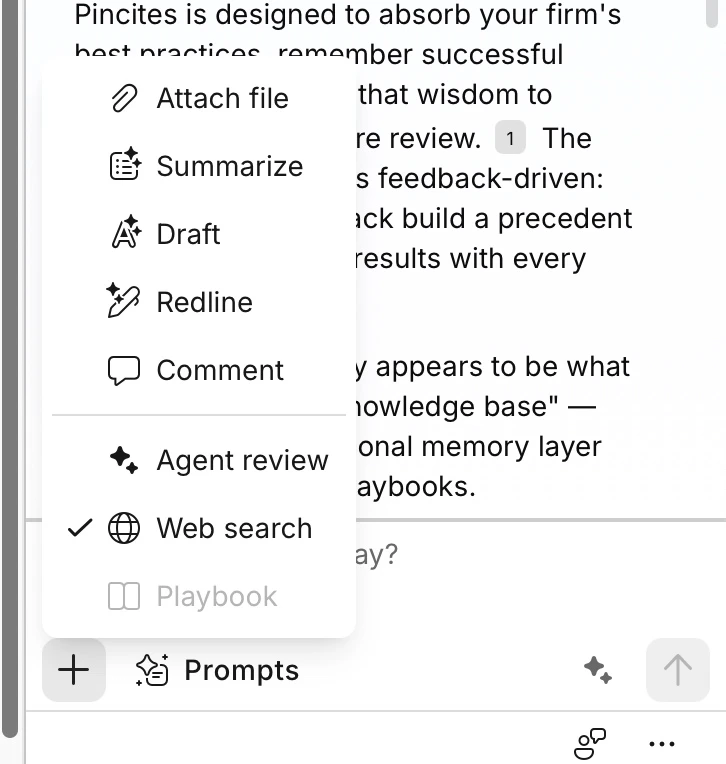
When research gets triggered
Composer performs web research when you ask about:- Recent case law or court decisions
- Current regulatory requirements
- Market standards for specific contract terms
- Statutory language or legislative updates
- Industry benchmarks or common practices
- “What are the CCPA requirements for data deletion?”
- “What’s the standard market position on liability caps in SaaS agreements?”
- “Has there been recent case law on limitation of liability in California?”
What happens during research
Query formulation. Composer determines what to search for based on your question. For a question about GDPR data breach notification, it might search for “GDPR Article 33 notification timeline requirements.” Web search. Composer runs the queries and retrieves relevant results from across the web. Content extraction. For each useful result, Composer reads the page content to pull out the relevant information. Synthesis. The findings get combined into a response that answers your question, with citations linking back to the original sources.Using URLs directly
You can also paste a URL into the chat and ask Composer to analyze it:- “Review this privacy policy: [URL]”
- “Summarize this article: [URL]”
- “Does this terms of service allow them to use our data for training?”
Citations
When Composer uses external sources, it includes citations so you can verify the information and access the original material. Citations appear as links within the response or listed at the end.Limitations
- Research adds time to responses since Composer needs to search and read external pages
- Some websites block automated access
- Information from the web should be verified, especially for legal advice
- Composer can’t access subscription databases or paywalled legal research platforms